My Journey After Her

  • I Want to Die: Four Words That Can Mean Two Different Things

    I Want to Die: Four Words That Can Mean Two Different Things

    A quick note before you read: this one gets into suicidal ideation, a hospital stay, and grief. If any of that is heavy for you right now, take care of yourself first—the 988 Lifeline (call or text) is there any time, day or night.

    I just finished Hacks. I can’t say I loved it—not really my cup of tea—but it certainly left an impression. Chock-full of memorable lines, one of which has stuck with me since I first heard it.

    Season 4, Episode 6: Ava angrily quits her job and walks down to the beach at night. Deborah tracks her down, mistakes another redhead in the ocean for her, and swims out fully clothed to rescue the wrong woman. When Deborah turns around and screams, “I thought you were drowning yourself!”, Ava sighs and replies, “Yeah, I’m not suicidal. I just want to die.”

    One morning, a few months after losing my wife, I found myself in the hospital. The whole incident is kind of a fog-induced blur—I just know that I was scared. The official diagnosis was severe depression with suicidal ideation. When I heard the word suicide, years of repressed Baptist guilt came rushing to the surface, and I suddenly felt like I was doing something wrong, as if there were a right way to grieve. I didn’t know how to unpack the word, or what it meant to—or for—me.

    I’m not suicidal. I just want to die.

    People hear “I just want to die” and think it’s about ending something. It isn’t. It’s about the fact that something has already ended.

    When you lose the person you built your future around, you don’t just lose them—you lose the future itself. Every plan that had her in it. Every version of getting older that assumed her name would still be there. That future didn’t fade or change shape. It died the same day she did.

    So when I say I don’t want to be here, I’m not talking about here as in alive. I’m talking about here as in this version of the world; the one where I’m asked to build a new future out of a life I never chose and never wanted. Nobody gave me a say in it. I just woke up one day and the future I’d been living toward was gone, and everyone expected me to want a different one instead.

    That’s not a death wish. That’s grief refusing to pretend the math still works.

  • Phuck Cancer (And the Rag That Outlasted It)

    Phuck Cancer (And the Rag That Outlasted It)

    When I first picked up the rag it was approximately 1 a.m. My wife, Katy, had been in surgery for two hours at that point. I was in the hospital cafeteria trying to distract myself by reading. I needed to take my mind off the surgery; my brain has always been good at worst-case scenarios.

    I tried cranking the music I was listening to. I’d made a playlist the other night as I listened to my wife being cheno-sick in the bathroom. The title was “Phuck Cancer”, and it was filled with mostly aggressive tunes — hard rock, metal, Slipknot, DEATH, you get the idea. Currently TOOL was reminding me how fucked up the world is when I realized all Maynard and the boys were doing tonight was exacerbating my current state of anxiety. “Sorry Maynard, I figure you’ll get it,” I thought to myself as I removed my earbuds. Once my buds were tucked away, I gave reading another shot.

    It was really Katy’s idea that I bring a book. I knew I wouldn’t be able to read while she was in surgery, there was no way my anxiety-ridden brain was going to allow me to read a book. But I also knew Katy would feel better knowing I had a book with me. I require the ability to listen to music at any given moment; Katy was the same way with books. I swear that woman had a book in every purse, bag, and pack she carried. She took three with her for the hospital stay. So, I went along with the idea and picked something I’d been meaning to read but always found some excuse to put off.

    I sat alone in the large, low-lit cafeteria and tried again to make it through a sentence. The words wouldn’t settle. I stumbled over them like a shopping cart with a bad wheel, unable to get any traction. After a few lines, I stopped. I didn’t bother marking my place. In that moment, it felt pointless.

    I was sweating, again. I’ve always been a heavy sweater, and when I’m nervous those sweat glands put in overtime. I’d been sweating since Katy and I crossed the threshold of the hospital. Honestly, I’d been sweating since the surgery was scheduled. Her doctor had even asked if I okay after her speech about possible complications, a discussion she assured us she had with every surgery patient for transparency. I could appreciate her intention, but all she managed to do was hand my inner movie director another set of worst-case scenarios. And I was beginning to suspect that director was some cross between David Lynch and Stephen King, with a dash of Tom Savini for pizzazz — some seriously twisted stuff played through my head most nights.

    I grabbed a stack of cafeteria napkins, the brown, worthless kind — essentially just a thin strip of cardboard, non-absorbent. It took three stacks to get my head dry, and then I did another pass with my bare hands to check if any pieces had ripped off and stuck — you’d be surprised what sticks to a bald man’s head when he’s sweaty. My nieces were once entertained for an entire family picnic testing that exact theory with whatever they could find lying around.

    As I stood, I could see the golden arches of McDonald’s through the window. I checked Google Maps — confirmed, walking distance and it was a 24 hour joint. Sometimes a greasy gut bomb is just what the doctor ordered.

    It was cold out and I would be bundled up for the walk. The wind had picked up, and the city streets became wind tunnels in February. I knew between the jacket and my ski cap that I’d be dripping with sweat by the time I arrived, so I started to grab another stack of the useless napkins when I caught sight of some rags on the buffet counter. I walked over and grabbed one, looked around to see if anyone was watching, then glanced up at the ceiling for cameras. Bingo — there were a couple, but they were both pointed at the registers, so I was out of sight. The rag was coarse, not made for rubbing skin — industrial, made to scrub more than absorb. Not the best choice, but it would do. So, it came with me.

    Katy’s surgery was successful, but the cancer was persistent. I held onto that rag and would use it many times over the next few years. In the end, she chose to stop treatment and let fate decide. Well — fate can be a real fucker sometimes. My wife, Mary Katherine (Katy) Jordan, passed away peacefully at home in 2025. I discovered early in her treatment that if I rested a finger on her chemo port, I could feel her pulse. Sometimes at night, especially during her roughest nights, I would fall asleep with my hand there. That evening, sitting on the edge of the bed, I held her hand with one of mine, and with the other I rested my finger on her port. I stayed there until I couldn’t feel her pulse any longer.

    I used the rag to wipe away my tears later that night. In the immediate aftermath, that rag was a kind of grounding tool. In the fog of grief, the more I held it, the more I used it, it slowly became one of those items I used daily. Some days during work it would be balled up in my hand like a makeshift stress ball. Other days I took it with me shopping, it was draped loosely over the shopping cart rail, not for protection from germs, it just feels good under my palms, and it keeps me from screaming “Please move your cart from the middle of the FUCKING AISLE” while I shop. When doing yard work, I often would drench it with cold water, let it sit in the fridge for a couple hours, and then drape it across the back of my neck — something she used to do with a paper towel when I came in from a hot day.

    It just became normal. And when you’re grieving, normal is important.

    I’ve tried to throw it out. When it ripped, I instinctively reacted by moving it to the trash. I ended up standing over the bin, rag in hand, looking at it differently. There was an importance to it now — it was part of my story. Incidental, maybe, but still a part of it. And if I’ve learned anything from this experience, it’s that even the little things can mean so much. In that moment, the rag felt heavy. Not a heaviness that would’ve made it easier to drop into the trash, but a heaviness that made it cling to my hand. Not stuck — it literally felt like it was clinging, as if letting go of it was a mistake.

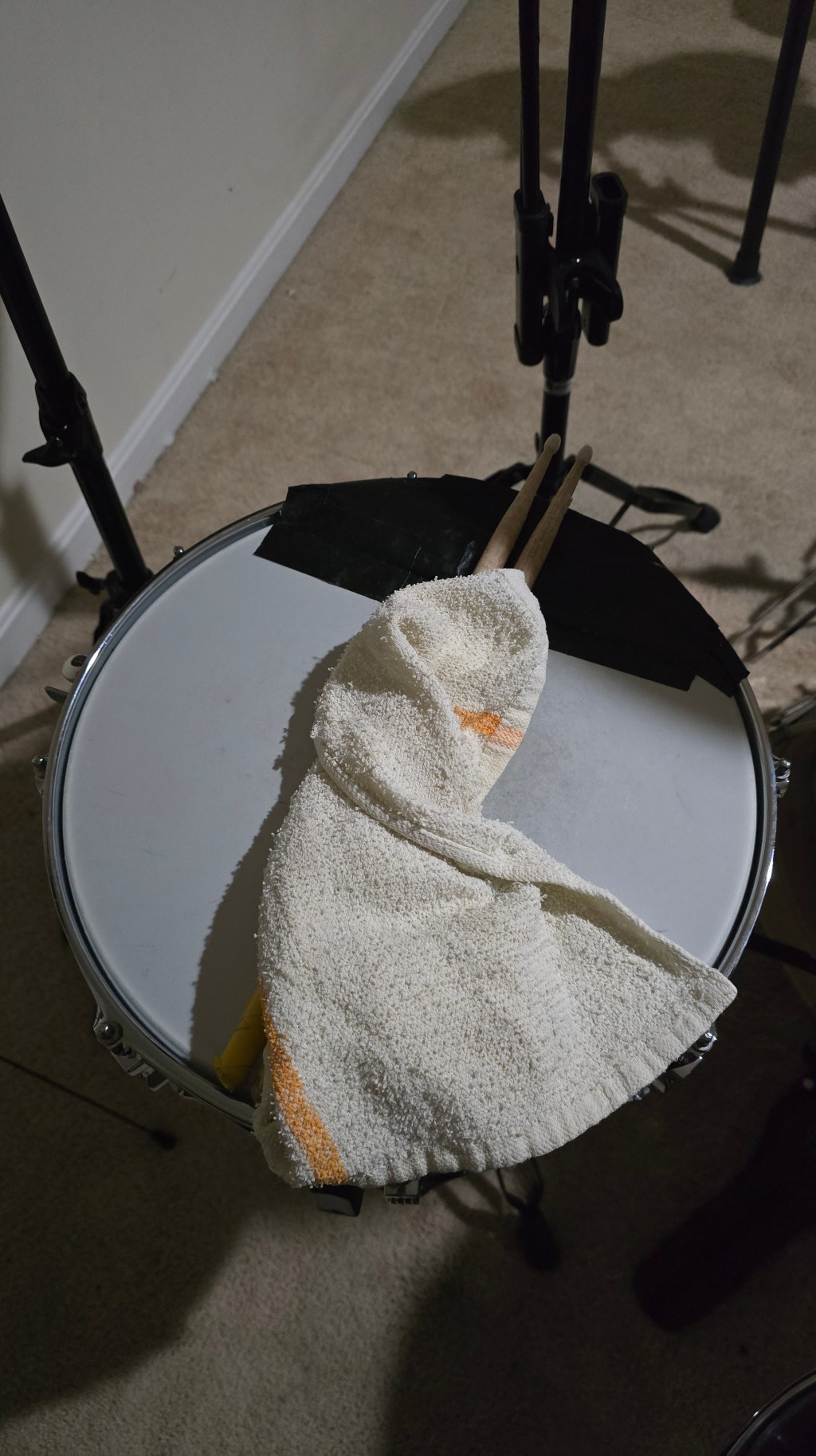
    It has a home with my drum set now. It’s my sweat rag when I play, which is appropriate — Katy would often watch me play. I don’t understand why the rag is so important to me now, but I’ve never been one to ignore those internal checks and balances that keep me sane. I’ll hold onto it until I don’t need to anymore. I’m sure that someday it will have served its purpose.

    I’m sure even Linus gave up his blanket at some point.

    …Right?

  • What the Music Carries Now

    What the Music Carries Now

    I love how music grows with us. It held our hands through high school, helped us find our voice as young adults, and now, as Gen X begins to enter “old age,” music becomes a connection to our past.

    We find ourselves returning to specific songs or albums in times of stress or trauma. We find comfort or strength in them; they help us remember better times.

    I have a few songs and albums that are forever altered by my experience over the almost six years watching cancer destroy my wife. Each one touched by Katy, but with cancer lingering close behind.

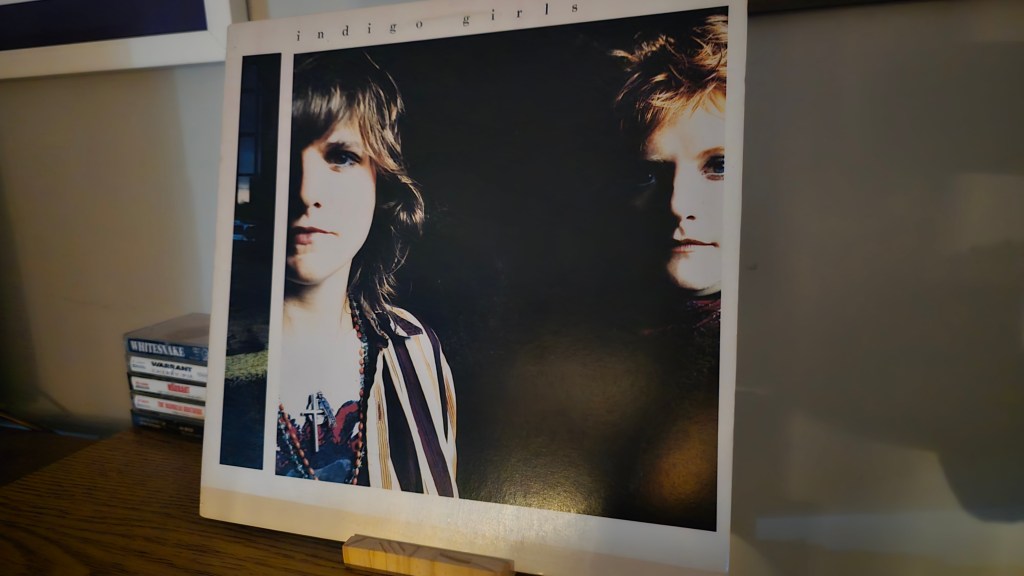
    Listening to this album is tricky now that I’ve lost her. It takes me back to a sunny weekend morning a fresh pot of coffee, Katy working a crossword on the couch with two puppies at her sides. I put on Indigo Girls, and at first she just hums along. By the second verse, she puts her lungs behind it, and the house fills with her beautiful voice.

    But these memories always come with the pain. It gets easier, little by little, to hold the pain back and sit with the peace a while longer. Still, sometimes the pain comes on too fast, and it’s hard to fight back the tears.

    It’s not all bad, though. Those memories bring her back to me for a time.

    Brief as it may be, it’s precious.

    So the music in my life continues to grow with me. And like so much else in my life, it too has to adjust to the trauma of Katy’s death. Yes, there is sadness in the songs, but there is also happiness. They carry Katy with them now. I can hear her, singing. Pitch perfect.

    *Record scratch. Freeze frame.*

    Nearly seven years into our marriage, pre-cancer, we were in the car headed to visit family. “Another Brick in the Wall” came on the playlist, and I started singing along, quietly. She hummed along too. Suddenly she stopped and turned to me.

    “What are the lyrics there?”

    “Uh… we don’t need no… “

    “No! What does he say before the ‘leave those kids alone’ part?”

    “Oh, you mean ‘hey, teacher’?”

    She started laughing, hysterically. I couldn’t help but join in. After a few minutes, she caught her breath and said, “I thought they were screaming ‘hey, preacher, leave those kids alone.’”

    The laughter started again, and it lasted until we arrived at her sister’s house. And then again when she told the story over dinner.

    So now, every time “Another Brick in the Wall” comes on, I don’t hear Pink Floyd. I hear Katy, gasping for air, laughing at herself. So I’ve got that going for me, which is nice.
     

  • A Target Shelf, a House-Elf, and a Memory

    A Target Shelf, a House-Elf, and a Memory

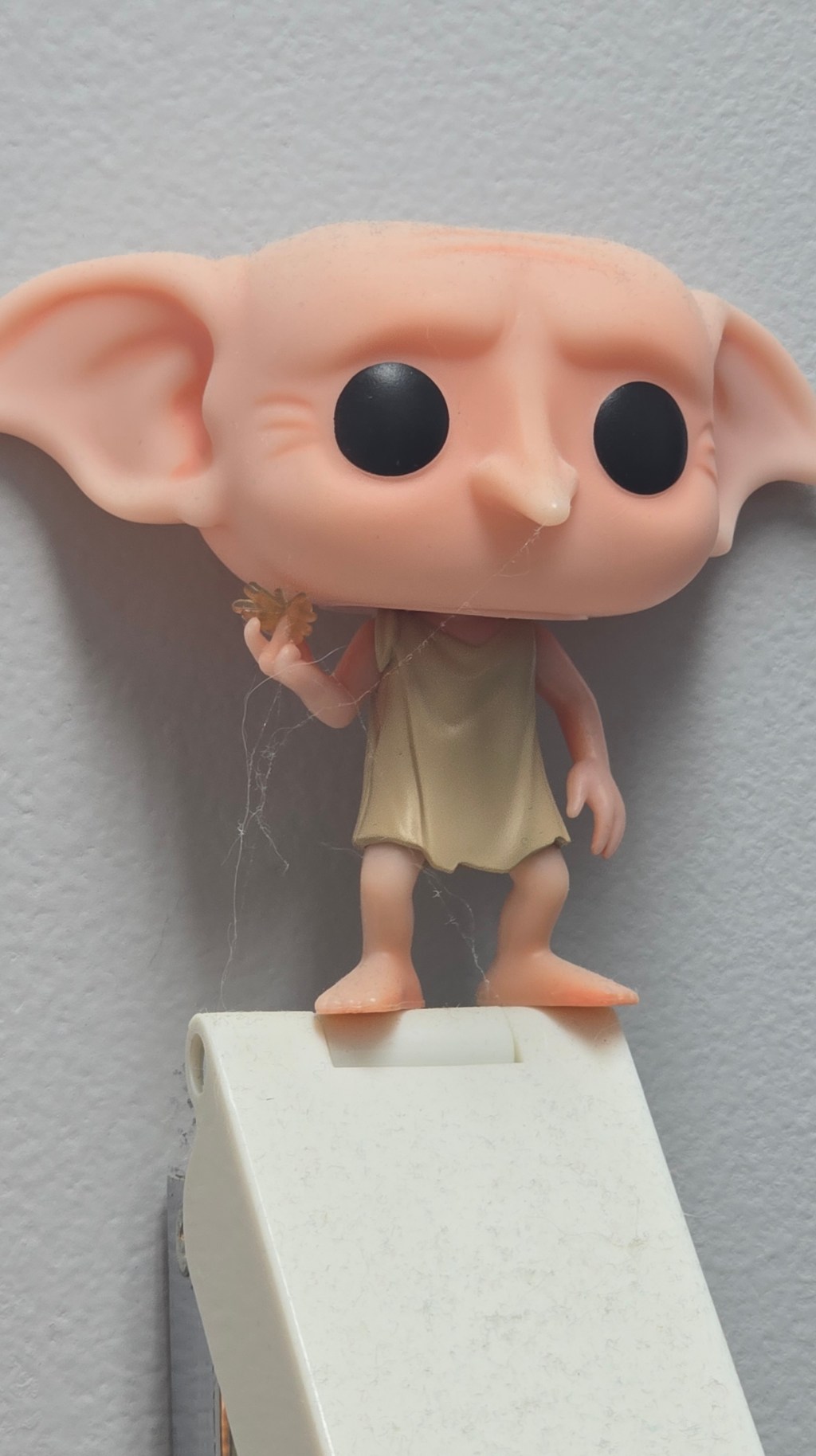
    She actually squeaked when she spotted Dobby sitting on a shelf in Target.

    Give her a character who’s misunderstood, picked on, beaten down, or carrying some emotional weight that nudges them toward bad choices, and she latches on instantly—like a mother desperate to protect her child.

    We never had kids—by mutual decision early in our relationship—but I think that instinct never disappeared. It just found somewhere else to go. You can see it in how she reacts to characters like Loki in the MCU, or Sméagol in Lord of the Rings.

    That need to nurture, to shield something vulnerable, didn’t fade—it just shifted. From the idea of a family to a shelf full of pop culture misfits who, in her eyes, deserve someone in their corner

    Dobby hit her hard. The moment he first appeared in Harry’s bedroom, she was hooked.

    So, I wasn’t surprised when she picked him up and looked at me with those “can I?” eyes—the same look I’ve perfected and used on her at least three times as often as she’s ever used it on me.

    I folded, like I usually do, and just like that, we had our very own house-elf.

    I hadn’t thought about him in a while—sorry, Dobby—until I noticed the little cobwebs. Instantly, I was taken back to that Friday evening wandering through Target with her.

    I took him down, cleaned him off, and gave him a new spot. I find myself doing this a lot now that she’s gone—shifting.

    There’s nothing that can prepare you for a loss like this. Over the past year, I’ve had to shift into a life of being single again. But it’s nothing like being single before I met Katy. Everything is different.

    So, I shift, again and again, just to keep from stumbling along this new path.

    Much like Dobby, I find myself in a new place—or at least learning how to shift into it. With a new perspective, and maybe just a little bit of magic, I think I’m going to be okay.

  • The Catharsis of Noise: Finding Peace in Punk After Loss

    The Catharsis of Noise: Finding Peace in Punk After Loss

    As I was processing my wife’s death, I listed to a lot of music. TOOL helped me process the anger and guilt, Pink Floyd made me look inward,and RUSH connected me to better times of my youth. John Denver and the singer-song writers of the 70’s connected me to Katy; she loved Jim Croce. I would mix in various playlists along the way; Apple is a good source of music – 80s Movie Soundtracks and Classic Punk Essentials have become regular plays.


    Classic Punk, the 70’s and 80’s era, is a genre I’ve hovered around for some time. Every heavy metal fan dips their toes into the Punk pool at some point. As a teen groups like Black Flag,The Dead Kennedy’s and the Ramones were known to me. Husker Du and The Melvins I was aware of, and I did not even consider Elvis Costello or the Police as early Punk examples! The longer I hung around the genre, the more I recognized that it is the perfect soundtrack for grief. I understand the hesitancy to accept this one, but hear me out. It’s a record I’ve been playing for the past few years; I think I can make a good argument.


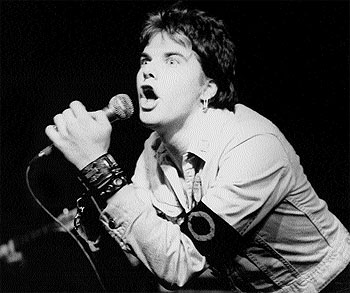
    The first side of this record is about anger and aggression. I was on the edge in those early months after she died. I couldn’t tell you why I was angry, At GOD maybe, Katy for hiding her scans from me. I was a boiling kettle of emotions. Anger is embedded in the fabric of punk. Political and Socio-Economic rage, anger at the mainstream, alienation. These were constant themes in the music. Watching Darby Crash writhing on the stage while singing (Or mumbling, if I am being honest) Manimal was kind of cathartic. Rollins screaming in my ear “Drinking black coffee, staring at the wall / Anger and coffee feeding me” as I would do that very thing was a special moment in my mornings.


    The early stages of grief can be filled with a lot of anger, a volatile, aggressive anger that burns hot and doesn’t know where to go. Listening to punk gave that fury a home; it channeled those ugly, overwhelming emotions into something constructive. But things shifted completely when I sat behind a drum kit. Learning to play those songs was a whole different level of relief. Hitting the drums became a physical manifestation of my pain. Every snare hit was a scream, and every kick drum was a way to smash through the wall of numbness, exhausting the anger until there was finally room to breathe.


    Let’s look at the second side of this record: chaos. Punk is chaotic, and so is grief. When you lose a life partner, your world rips in half. You are forced to navigate a terrifying new space without the one person you trusted implicitly. Early punk bands mirrored this exact shift. They lacked talent but possessed an abundance of passion and raw emotion. Those kids didn’t know what they were doing, yet they played anyway. This DIY ethos was famously summarized in a 1977 zine cartoon: “This is a chord. This is another. Now form a band.” The priority was raw, unpolished survival over formal ability.


    When you first arrive in Griefville, everything is raw fury. Like those early punks, you have no idea what you are doing. It’s like waking up, swinging your feet out of bed, and stepping directly into ice-cold water when you only know how to doggie paddle. For me, punk music was the life preserver. Those kids just wanted to make noise and share it with friends. They surely questioned if it was worth it, breaking through walls of self-doubt to realize the music was saving them. That is the heart of punk—it isn’t about perfection, it’s about survival. I am channeling that exact, unpolished chaos to fight my way through the suffocating chaos of grief.


    I never thought I’d rely on punk music for my mental stability. But then again, most of my fellow Gen-Xers are finding that everything in our 50s falls into the “I never thought I’d experience this” category.


    Punk is the perfect companion to grief. Everyone’s soundtrack looks different. Some choose to cry alone in a dark room; others want to smash things. Mine is built on raw screams, out-of-tune guitars, and a blood-soaked Darby Crash reminding me I’m not alone.

  • When a Band Tee Was My Armor

    When a Band Tee Was My Armor

    Here’s a hot take to mull over this weekend: genres make adolescence survivable. After that, they don’t carry quite the same weight.

    I should admit this entire argument was born out of a three-hour plus conversation with an old friend last night. After stuffing ourselves with Greek food from a newly discovered Uber option, we camped out in his garage studio and put on classic jazz – a genre we’ve both circled for years but never really tried to understand.

    At some point, I had to accept that my brain wasn’t going to just get jazz in one sitting. Once I stopped trying to decode it and just listened, something shifted. The music stopped being a puzzle and started being atmosphere.

    And that’s when the other idea crept in.

    Somewhere between the tzatziki and my failed attempt to “understand” jazz, it hit me: genres feel a little like high school cliques. Intense at the time. Slightly embarrassing in hindsight.

    When we’re young, genre is oxygen. Not because we’re experts, but because we’re overwhelmed. At eleven, you’re dropped into a social ecosystem with no map and a rapidly mutating landscape. We don’t know who we are yet – but we know what we like.

    We inherit taste before we develop it. We latch onto whatever our parents, older siblings, or cool cousins say is fun or exciting. Then something shifts. Our brains start recognizing the sounds, stories, and aesthetics that make us feel something, bigger, safer, louder, less alone. We begin building small corners of identity around those pockets.

    Not because we’re deep. Because it feels good.

    And in middle school, feels good is a perfectly acceptable survival strategy.

    Once high school arrives, genres shift from survival strategy to social armor. You don’t just like things anymore, you wear them. You defend them. You let them speak first so you don’t have to. A band tee becomes a signal. A playlist becomes a perimeter. A movie obsession turns into shorthand for who you are and who you’re not.

    As a military brat, I changed schools a lot, genres became my social shorthand. A way to identify my people quickly. They were badges. Signals. Saying “I’m into Metallica,” or “I’m into NIN,” or “I’m into 2Pac” wasn’t just about taste. It was vital social information. It told me where I might sit at lunch. It shaped my posture, my attitude, even my emotional temperature.

    Half the time, these signals said more about the social world around me than the music itself.

    Genres reduce the complexity of self-definition at a moment when everything else feels overwhelming. It’s much easier to say, “I’m into this,” than, “Hi, I’m Matt. I stumble over my own words when I get excited, I have crippling self-doubt, and my feet sweat unnaturally.”

    And then there’s the emotional instability of the typical adolescent. It’s the only phase of life where a song can ruin your week and a look in the hallway can trigger a three-hour identity crisis. Genres offer predictability. Predictability creates safety. When you know a genre, you roughly know how it will make you feel.

    Horror promises controlled fear.
    Fantasy promises escape.
    Pop promises familiarity.
    Comedy promises relief.

    As teens, who feel everything at 11, that predictability matters. Genres become tools for emotional regulation as much as entertainment. You didn’t just watch a horror movie; you managed anxiety through something structured. You didn’t just blast a breakup song; you let it hold the feeling for you.

    And then something shifts.

    Around thirty-five, I began to notice my tastes widening. It started with exploring metal subgenres. That led to folk. Folk led to bluegrass. And so on. The lanes blurred. The guardrails started to feel optional.

    None of this is me saying you’re some underdeveloped Neanderthal if you stay in your lane. I get it. I’ve logged plenty of hours inside the warm, predictable borders of the familiar – convincing myself I had “refined taste” when really I just didn’t want to feel lost again. There’s comfort in knowing exactly what you’re going to get. There’s nothing wrong with returning to what steadies you.

    The point isn’t to abandon categories. It’s just to recognize we don’t have to hide behind them.

    Which explains why rewatching as an adult can feel both comforting and faintly embarrassing. The thing that once felt like a personality turns out to be… a phase. But it was a useful one.

    Rewatching isn’t about reclaiming that armor. It’s about examining it, dents and all. Seeing what it protected. Seeing why we needed it. And quietly thanking it for getting us through a time when liking something felt a lot safer than knowing ourselves.

    Rewatch / Replay — experiencing it again, a little steadier this time.

  • The Conversation Outlived Her

    The Conversation Outlived Her

    The hardest part of grief right now isn’t the sadness. It’s the silence.

    The sadness is still there. It always is. But now that the chaos has settled, now that the noise of survival isn’t quite so loud, I find myself missing the conversation. Missing my co‑conspirator.

    Talking with Katy was never difficult. We skipped right over the early dating stage, the awkward interviews disguised as small talk. There was no careful positioning, no trying to appear more interesting than we were. We fell into a cadence immediately. Open. Familiar.

    It felt less like meeting someone new and more like finding someone who had just stepped out of the room years ago and finally came back.

    Katy was a firm believer in karma and was convinced we had known each other in a past life. That was her explanation for how quickly we clicked. She pointed to that first night on Bob’s porch, when we talked until four in the morning.

    To her, it wasn’t a beginning.
    It was a continuation.
    A long‑overdue catching up.

    And we talked.
    A lot.

    The house was never really quiet. If it wasn’t filled with dogs barking, drums, or Bill Kurtis guiding her through another heinous murder, it was our voices bouncing off the walls. Sometimes the conversation was ignited by something that happened to us, we needed to vent about a stupid decision or a wasted moment. Other times, we talked about the movies and books we’d experienced on our own. Katy and I had very different tastes, but we met in the middle often and dissected each other’s thoughts. We even had a YouTube channel before cancer decided to cancel our production schedule.

    After her diagnosis, we spent every night talking. I made it a point. I didn’t care how tired I might be the next day. I had to consume as much of her as I could while she was still here.

    I’d start with something simple.

    When was your first kiss? Who was it?

    Or

    Most embarrassing family moment?

    When the doctor approved THC for pain, things got weird. Especially Katy. All the southern etiquette her mother had instilled quietly packed its bags and left the building. Suddenly it was:

    What was the most embarrassing moment during sex?

    Or

    Favorite fake sex scene in a movie?

    These conversations didn’t stay in the room. They followed us into the next day. The nurses in the infusion ward were often treated to whatever strange thread we’d refused to let die overnight.

    Then she was gone.

    And for the first few months, there was nothing.

    No voice.
    No imagined responses.
    No phantom conversations.

    Just blank space where she used to be.

    My brain, apparently, understood the assignment. She was gone. Conversation terminated. No appeals process.

    It wasn’t peaceful.
    It was functional.

    Like a house after the furniture has been removed. You can still live there, but there’s no reason to linger.

    And then one day, without ceremony or permission, I started talking to her again.

    I don’t remember what triggered it. Something small. Something she would’ve had an opinion about. I said it out loud before I realized what I was doing.

    And I didn’t stop.

    I still talk to her. Out loud. In the car. In the kitchen. Standing in the middle of a room with no reason to be there. I tell her things she would’ve cared about. Things she wouldn’t have cared about but would’ve listened to anyway.

    These conversations are tangible. They have structure. Timing. Rules.

    I still pause where she would’ve interrupted. I still defend my position, knowing full well she would’ve dismantled it in under ten seconds. I still leave space for the look she would’ve given me when I said something particularly stupid.

    Grief hasn’t taken the conversation.
    It’s just forced me to perform both roles.

    On some level, I know what this is. My brain refusing to accept the sudden vacancy of its primary tenant. Keeping the lights on. Pretending the lease wasn’t terminated without warning.

    My brain has carried a lot over the past ten years. Mom’s dementia. Katy’s cancer. Two dogs. Two jobs. Entire versions of my life quietly removed while I stood there holding the receipts.

    If this is what it needs to keep from snapping, so be it.

    And yes, I’m aware of the irony. Talking to someone who isn’t there as a way to stay sane.

    Fully aware.

    But that’s grief.

    It doesn’t take everything at once.

    First, it takes the person.

    Then it leaves you alone in the conversation.

  • Children of the Corn — Would She Have Liked It?

    Children of the Corn — Would She Have Liked It?

    My wife and I were both Stephen King fans.

    Katy was already neck‑deep in King’s world when we met. I was more of a casual reader. Caught up on the essentials, dipping into some deep cuts and the non‑horror titles. Somewhere along the way, it stopped being about catching up to what she’d read. It became something we shared. We built our own little King universe: books stacked on nightstands, adaptations queued up. If his name was on it, it felt like it belonged to us.

    Watching the adaptations became a ritual. When a new film was announced, we’d reread the book first, sometimes out loud to each other, to build anticipation. It was our version of foreplay. We did it with The Hobbit and anything by Dennis Lehane too.

    Just nerdy, literary foreplay.

    I’ve been avoiding this one.

    Partly because we never loved the original short story. And the ’80s adaptation was one of those classic “meh” King efforts. Not terrible. Not great. Just… there.

    But mostly because it’s on the list of things we missed. Katy will never get to see this version. We had chances. Life got loud. Appointments. Fatigue. Timing. And now there’s that tiny whisper of should’ve, could’ve, would’ve that attaches itself to the dumbest things.

    The other night, I was bored, lightly stoned, and saw it streaming. I try to support horror when I can, so I rented it and pressed play.

    Don’t worry, hon. You didn’t miss anything.

    Let me explain.

    1. The PowerPoint in the Corn

    Instead of a troubled couple stumbling into a creepy farming town, no adults, blood‑stained walls, a suffocating sense of dread, we get a tree‑hugging teen who wants to escape her town and take down Big GMO. The political messaging wasn’t subtle. It was laminated and stapled to every scene.

    Now, I’m not anti‑politics in horror. Some of the best horror stories are political at their core. But there’s a difference between subtext and a PowerPoint presentation. The opening beat already told us everything. We didn’t need it re‑announced every twelve minutes.

    And the wardrobe choices for that poor young actress? Those weren’t shorts. Those were evidence exhibits. I kept expecting Chris Hansen to walk in, pull up a chair, and calmly ask me, “Care to explain what you thought was happening here?”

    2. Spirit Halloween Presents: Evil

    Why. Do. They. Keep. Showing. The. Corn.

    As I mentioned, Children of the Corn isn’t one of King’s stories I return to. But even I can admit the original power of the story was the unseen entity. The thing in the fields. The suggestion.

    Let it breathe in the imagination.

    Instead, we get what looks like Groot on meth. If Groot were assembled from rejected cornstalk props at Spirit Halloween. When horror explains itself too clearly, it becomes a little less scary.

    Now, I’ll be fair: the scene where the corn monster tears that woman apart? That was GNARLY!!!. Credit where it’s due.

    3. Violet Beauregarde Starts a Religion

    They leaned hard into Lord of the Flies energy, but without the psychological weight to support it. The lead cult kid was clearly talented; the actor did the job. I just hated the character choices.

    Instead of quiet, eerie, neighbor’s‑cat‑definitely‑didn’t‑die‑naturally creepy, we get full‑volume Violet Beauregarde with a megaphone. She wasn’t unsettling. She was obnoxious.

    I didn’t fear her. I wanted someone to punch her.

    Would Katy have liked it?

    Nope. I can even pin-point the exact thing that would’ve made her cringe. The main protagonist, the young Captain Planet fan‑club president. That weird Disney Channel child‑actor cadence. Everything bigger than it needed to be. Katy hated that.

    So no, I’m not recommending this one. It’s an hour and thirty‑three minutes of your life you won’t get back. If you’re craving cornfield horror, watch the original. It’s campy, sure, but it’s the good kind of camp. The kind that smells faintly like basement carpet and microwave popcorn.

    And if someone finally punches Violent Beauregarde? Let me know. I’d pay the full $70 movie‑theater experience just to see that.

  • She Knew I’d Get Here

    She Knew I’d Get Here

    I heard “The Story” by Brandi Carlile for the first time today.

    Not “first time” like I’d never heard it before. Katy and I were fans. Well, Katy was the real fan. I was more of a casual participant. Still, Brandi’s music lived in the background of our life. Car rides. Target aisles. Saturday mornings.

    Katy tried to get me excited about her. I’m pretty sure she used “The Story” as Exhibit A. Not pushy. Not dramatic. Just her quiet confidence, the kind that didn’t argue or oversell. She’d just press play, like she knew I’d catch up eventually.

    For whatever reason, I wasn’t ready to hear what Brandi was saying.

    I have a lot of time to listen these days. So after some internal negotiations, I put the song on. No distractions. No emotional armor. I just let it play.

    By the time she lands on I was made for you, every moment my wife had tried to get me to listen came rushing back. Every “I’ll check it out later” that never happened. Every missed chance to meet her inside something she loved.

    Now I hear it.
    And I wish she were here so I could tell her she was right.

    Our relationship started with music. I once burned her a CD, hand‑picked tracks, romantic as hell, basically a sonic declaration of devotion. And there she was, years later, trying to hand me a song that said the same thing back. I just didn’t recognize it at the time.

    How many car rides did it play?
    How many times did she belt it out in the shower?

    She was sharing.
    I was half‑listening.

    If I had truly heard “The Story” in that first year after she died, it would’ve wrecked me. Back then, the emotion was too raw. The reality of life without her was a bruise I kept pressing just to make sure it still hurt. I’m sure I skipped it. Changed the station. Found something safer.

    I wasn’t ready.

    Now? It still hurts. It always will on some level. But I hear what she was telling me in the words Brandi wrote. She loved me. She was meant for me. I was meant for her.

    That’s what a great song can do.

    A good song makes noise.
    A great song makes a home.

    It settles in quietly, plays in the background of your existence, and one day you realize it’s been there all along. Just waiting for you to be ready.

    I didn’t cry. I didn’t need to.
    I just sat there and let it be true.

    And honestly?
    That felt like progress.

    And somewhere, out there in the dust of whatever this is, I can almost hear her:

    “Seriously!? Now you decide to listen!? Asshole…”

  • Braveheart: Same Movie, Less Pull

    Braveheart: Same Movie, Less Pull

    Katy loved Braveheart. I mean, she deeply loved this film.

    Like a lot of Gen Xers, my wife Katy worked two jobs in her twenties. One of them was as a video rental clerk. She saw Braveheart in theaters three times, and when it landed on the in store rotation, she was the only employee who did not groan.

    She owned it on VHS. Then DVD. Then Blu ray. Then 4K. Then streaming.

    This was prime comfort movie territory for her.

    She watched it on infusion days. One afternoon, when I went back to pick her up, I walked into the treatment room and found two nurses crowded around her phone, watching the movie with her.

    She also loved a sappy underdog story.

    Sorry to the die hard Braveheart fans, but when you strip away the gore and the epically framed kilts, that is exactly what it is. An underdog story, with a sweeping romance layered in, very much in line with how Hollywood packaged these films in the 1990s.

    Katy would never quite admit this, even when I gently pointed out her suspiciously consistent enjoyment of heist movies.

    Ocean’s Eleven (2001)
    The Italian Job (2003)
    The Usual Suspects (1995)

    We can argue about whether those qualify as underdog stories, but the pattern is hard to miss.

    I honestly cannot tell you the last time I watched Braveheart when Katy was still here. It had become such a constant in our lives that it did not feel like something you watched. It was just there. What I do know is that it has hovered at the edges of my days ever since she died. Her love of that film tugged at me every time it popped up on a menu, every time I caught a piece of James Horner’s score. Even a dumb parody was enough to wake something I usually keep dormant.

    When she died, it went straight onto the no watch list. We will talk more about that list another time.

    Grief has a way of making ordinary things heavier than you expect.

    Even after I quieted the inner resistance enough to decide to watch it, I still had to follow through. That took a few more days before I was ready.

    From the opening camera sweep across the Scottish landscape, paired with Horner’s score, I felt myself slipping into the nostalgia blanket. Warm. Familiar. Comfortable.

    The first thing I noticed was that I kept turning away from the violence.

    This was not entirely new. A few nights earlier, watching Dr. No with my father, I found myself looking away from the karate chops and the bright red paint pools Bond leaves behind as he shoots his way through Spectre agents.

    That surprised me. I would not have flinched at this once. I have watched all three Human Centipede movies. By any reasonable metric, Braveheart should register as a Garry Marshall rom com at this point.

    But after walking through Katy’s cancer, even stylized, fake violence has started to unsettle me. Not because it feels real, just because something in me has shifted.

    I did not finish the movie. I stopped when they caught Wallace. I could feel that continuing was not going to add anything. I will come back to this another time. There is clearly a different post waiting to be written about my sudden lack of patience for Hollywood brutality.

    Watching Braveheart again also meant memories. Lots of them.

    It was often playing while Katy did crosswords, puzzles, or napped. During one of those half watching, half sleeping chemo days, I was sitting next to her when she suddenly said,

    “Do you think villages had horseshoe baths?”

    “What?”

    “Horseshoe baths. Every village needs a horseshoe bath.”

    Then it clicked. Braveheart was her nap movie that day, and we were at the early revenge scene, the one where the camera lingers on a horse’s hooves trudging through village muck.

    “Horseshoe baths” was an inside joke from a much earlier viewing. In her version of time travel, she planned to go back and install them in every village.

    She came up with this before the chemo friends.

    Even then, half asleep from exhaustion and dulled by treatment, she heard the movie clearly enough to spark a conversation. That is how deeply this film lived in her.

    Did I enjoy it?

    I suppose that is the natural question.

    I will say this. I do not think I will be watching it again.

    It is a very 1990s movie. It keeps returning to the same emotional notes, assuming that if you stay there long enough, the feeling will land. That does not mean I did not enjoy it. It is just not an experience I feel compelled to repeat.

    It is not about loyalty or betrayal. Watching it now does not feel like I am breaking some unspoken promise to her.

    It did not reduce me to tears the way I expected.

    I just do not feel the pull anymore.

    Without Katy, the reason has changed. What once mattered because she loved it now lands as just an okay movie.

    That is what changes on the rewatch.